


Which Cenote Will You Dive? Our Cancun Cenotes, by Name

Updated: 3 days ago
Every week someone writes to us with the same question: which cenote will we dive? And every week we give the same answer, which surprises people. We do not know yet, and that is on purpose. Manta does not lock in a specific cenote when you book. Your guide meets you, listens, looks at the day, and the choice is made together. So here is the menu: the cenotes our guides dive most, what each one is actually like underwater, and who each one suits.
A few things are true everywhere before we get to names. Cenote water is fresh rainwater filtered through limestone, and it sits around 75 F all year, cooler than the sea, so almost everyone wears a wetsuit. Every dive is guided, every diver carries a light, and these are caverns, not caves: you stay in the daylight zone on a fixed line. For the deeper story on how it all works, our cenote cavern diving FAQ covers it.
How your guide picks the cenote
Our guide Guillermo explains it best. With a nervous diver, the first thing he asks is what exactly makes you nervous. The dark? The depth? The feeling of a ceiling over your head? Every cenote is different on exactly those three things, so once he knows yours, there is a cenote that fits. The secret, he says, is that at the end of the day the decision is taken together.

It works the same at the other end of the scale. When someone wants the wildest thing on the menu, wild still depends on you: giant bells hanging in the dark, ice age bones, or a shallow cavern that feels like swimming through a National Geographic documentary. One person in a group will often push for a famous name that is past the group's comfort level, and choosing together is how we keep everyone honest. If you want one specific cenote guaranteed, a private tour is the way to lock it in.
Dos Ojos

The classic first cenote. Two round openings side by side, the Two Eyes, drop into gin clear water and a huge, easy cavern with a permanent line. Two routes give it two personalities: the Barbie Line is bright and open with sunlight following you most of the way, and the Bat Cave line is the full cavern feeling, darker, with a hidden air dome where bats live above your bubbles. Shallow, wide and forgiving, this is the cenote that turns ocean divers into cenote lovers.
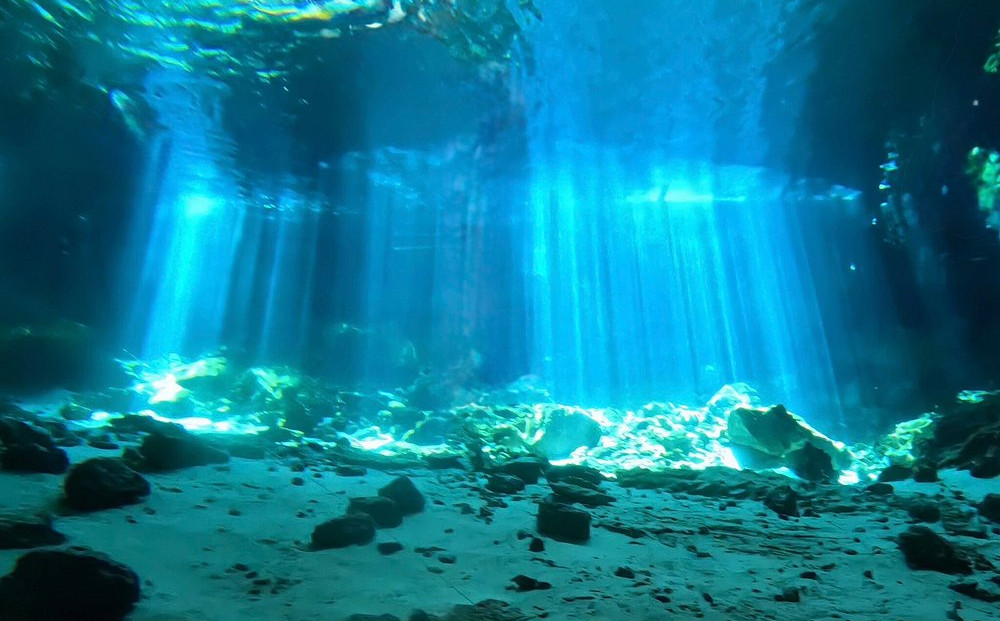
Guillermo's honest take: Dos Ojos is a marvel, and everyone knows it, so by midday it can feel more like a busy swimming hole than a silent jungle pool. He loves it anyway, because the shallow depth means long, relaxed dives, and he often pairs it with El Pit, a deep blue shaft of light beams a few minutes away, so guests come home with two completely different worlds instead of two laps of the same one.
Depth: about 10 m / 33 ft in the cavern
Two lines: Barbie (bright and open) and Bat Cave (darker, with an air dome)
Halocline: no. Sulfur cloud: no
Level: great first cenote, Open Water friendly
Area: Tulum corridor. Popular, quietest early
Tajma Ha

Guillermo's favorite of the shallow cenotes. He tells guests Tajma Ha gives you a taste of everything a cenote can offer in a single dive: fossils in the walls, formations, laser beams of sunlight that are strongest in the summer months, even some life in the water. It also has one of the sharpest haloclines anywhere, the layer where fresh water floats on salt water.
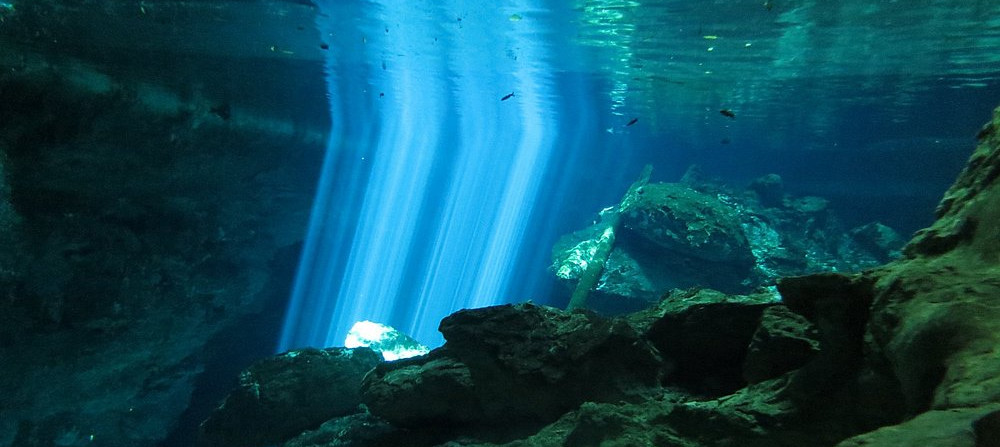
How do you describe a halocline to someone who has never seen one? Guillermo's version: it is as if the two waters were separated by a force field, or a sheet of plastic film floating in the middle. Swim through it and your vision blurs like oil in water, then snaps clear again.
Depth: about 15 m / 49 ft
Light beams: yes, best in summer. Halocline: yes, one of the sharpest
Profile: up and down, so easy equalizing helps
Level: better as a second or third cenote
Area: south of Playa del Carmen
Siete Bocas

Seven mouths, one giant room. Seven openings in the jungle floor drop into the same enormous chamber, around 70 meters across, on the Ruta de los Cenotes near Puerto Morelos. Stalactites up to five meters long hang from the ceiling, fossil shells and corals print the walls, and on a sunny day light falls through all seven mouths at once. Deeper and darker than the Tulum classics, it feels like diving inside the earth. It is also the cenote we tell guests to visit on a no-dive day: snorkelers get the sunbeams from the surface, divers get the cathedral.
Depth: up to 30 m / 100 ft
Seven ceiling openings with light shafts on sunny days
Deep sulfur layer. Fossils in the 15 to 20 m band
Level: experienced divers
Area: Ruta de los Cenotes, Puerto Morelos
Zapote, home of Hells Bells
The one guests talk about for years. Zapote is shaped like an hourglass: a narrow drop opens into a deep chamber where the Hells Bells hang. Our guides will tell you there are only three places in the world where you can see these bell formations, and that they are the only formation that, as far as anyone can tell, is still growing underwater. Below the bells sits a white cloud of hydrogen sulfide, fog over a ghost forest. One of our guests surfaced and asked, where were we? Because that was not planet Earth.

The bells are not even the whole story. This corner of the Ruta de los Cenotes keeps producing discoveries, from the bones of a giant ground sloth that died here in the last ice age to a Maya vase found as recently as 2024. Diving Zapote is the closest most of us will get to swimming through a museum. Deep, dark and unforgettable: this is the advanced diver's cenote.
Depth: about 30 m / 100 ft to the bells
Hells Bells: rare bell formations, still growing
Sulfur cloud: yes, the white fog below the bells
Ice age sloth bones and a 2024 Maya vase found in this system
Level: Advanced certification
Area: Ruta de los Cenotes, Puerto Morelos
Kin Ha

The hidden one, and Zapote's natural partner. You climb down wooden steps into the ground before you ever touch water, then descend a cylinder of a cenote where holes in the ceiling fire beams of light deep into the blue. The same rare bells that made Zapote famous decorate this system too, along with flowstone walls and a beautifully decorated air dome to surface into mid dive.

Our guides usually run Zapote and Kin Ha as a pair: one story, two chapters, told 30 meters underground. After the dive comes the locals' favorite part, jumping back in from the platform.
Depth: up to 30 m / 100 ft
Light beams through ceiling holes, plus a decorated air dome
Bells: the same rare family as Zapote
Level: experienced divers, usually paired with Zapote
Area: Ruta de los Cenotes, Puerto Morelos
Chac Mool

The friendly cavern with the famous halocline. Twenty five minutes from Playa del Carmen, Chac Mool gives Open Water divers the full cenote experience without the depth: wide sandy passages around 12 meters, sunbeams through the ceiling, an air dome to surface in, and a halocline so pronounced that instructors use it to explain what a halocline is. Two connected caverns share the site, and its little brother Kukulkan next door makes the classic second dive.

If Dos Ojos is the classic first cenote near Tulum, Chac Mool is its rival closer to home.
Depth: about 12 m / 40 ft
Halocline: yes, one of the most pronounced anywhere, around 8 to 10 m
Light beams and an air dome
Level: Open Water friendly first cavern. Pairs with Kukulkan
Area: 25 minutes from Playa del Carmen
How deep are the cenotes?
It is the question we get most, and the honest answer is that cenote diving is shallower than most people expect. Everything except Zapote sits inside recreational cavern limits, with a permanent guide line and daylight behind you. Here is the depth of each cenote on our regular list.
Dos Ojos, the two eyes cenote: about 10 m / 33 ft in the cavern. Dos Ojos cenote diving is the shallowest and easiest of the lot, which is why it is so often someone's first.
Chac Mool, also written chacmool: about 12 m / 39 ft. Wide sandy passages and a famous halocline.
Cenote Tajma Ha: about 15 m / 49 ft, on an up and down profile, so your ears do a little more work.
Siete Bocas: around 18 m / 59 ft in the main chamber, darker and deeper than the Tulum classics.
Kin Ha: about 30 m / 100 ft, a cylinder with light coming through holes in the ceiling.
Zapote: about 30 m / 100 ft down to the Hells Bells. This is the one that needs an Advanced certification.
Water sits around 24 C / 75 F all year in every one of them, so a wetsuit is normal even in August. Lights are always carried, on every cenote, on every dive.
Cenote Angelita
Angelita means little angel, which is a gentle name for the strangest dive on this page. It is not a cavern dive at all. There is no ceiling and no overhead: it is a flooded shaft, an open column of water about fifteen minutes south of Tulum, and you descend it like a lift.
At around thirty metres the water stops being water. A layer of hydrogen sulfide sits flat across the whole cenote like fog lying over a field, and dead trees stand upright through it with their branches reaching up out of the cloud. You hover above it first, because everybody wants a minute to look. Then you drop through, and for a few seconds you lose the world completely, and come out underneath in salt water looking up at the underside of a cloud from below. Nothing else we dive feels remotely like it.
The honest part. This is a deep dive. It is past thirty metres before you have seen the main event, bottom time is short, and the margin matters. Advanced Open Water is the minimum and we will ask what you have logged recently before we agree to run it. If your last dive was two years ago, this is not the one to come back on.
Checklist:
Depth: about 30 m / 100 ft to the cloud, over 60 m / 200 ft at the bottom
Type: open water, no overhead, guide line throughout
The layer: hydrogen sulfide, looks like fog over a drowned forest
Halocline: yes, salt water sits below the cloud
Temperature: about 24 to 26 C above the cloud, nearer 22 C below it
Level: Advanced certification with recent logged deep dives
Area: about 15 minutes south of Tulum
Booking: special request, arrange it when you book
Car Wash, or Aktun Ha
The name is the least romantic thing about it. Taxi drivers used to pull in and wash their cars in the water here, the nickname stuck, and now almost nobody uses the real one. It is Aktun Ha, about eight kilometres west of Tulum on the road to Coba.
It is the opposite of Angelita in every way. Shallow, open, bright, and covered in water lilies that let the sunlight through in broken pieces. There is a proper cavern section for divers who want the ceiling over them, and a wide open basin for those who do not, which makes it one of the easiest cenotes to put a mixed group into. Mid morning is when the light does its best work.
One seasonal warning. Through the summer, decomposing leaves build a tannic layer across the surface. You descend through water the colour of tea into perfectly clear water below, and when you look back up the whole surface glows yellow and orange. Some guests call it the best thing they saw all week. Others wish they had come in spring. We will tell you which it is doing before you commit.
There is also sometimes a small crocodile living here. Genuinely harmless, far more interested in the sun than in you, and your guide will know exactly where it is before anybody gets in the water.
Checklist:
Depth: about 14 m / 46 ft
Type: open basin plus a cavern section, your choice
Light: water lilies and sunbeams, best mid morning
Seasonal: tannic surface layer through the summer months
Halocline: no
Level: Open Water friendly
Area: about 8 km west of Tulum toward Coba
Booking: special request, arrange it when you book
The wild cards
The six above are our regulars, not the whole list. Ask your guide about their personal picks. Guillermo's wild card is Taak Bi Ha, one of the shallowest cenotes around and still the one that feels most like a true cave from a documentary, with a low ceiling and formations everywhere. Cancun's underwater caves country never really ends, and that is exactly why we choose together.
The next two are special request only. Both sit further south, past Tulum, so they are a longer drive and a longer day than our regular run. They have to be arranged when you book rather than decided on the morning of the dive, and they work best as a private trip. Divers who ask for them usually have a specific reason, and both are worth the extra hour in the van.
Ready to drop in?
Our Cenote 2 Tank runs from Cancun with transport, tanks, weights and a guide who knows every one of these places by heart. Come with a nervous grin or come chasing the bells. Either way, the right cenote will find you.
M A N T A
D I V E & S N O R K E L C A N C U N
Toll-Free 1-800-659-0712
Local Phone/WhatsApp +52-998-238-2116
Email info@mantadivers.com
Marina Del Rey, Blvd. Kukulcan Km 15+656
Hotel Zone, Cancun, Q.R. 77500
Facebook · Instagram · WhatsApp · TripAdvisor


Comments